

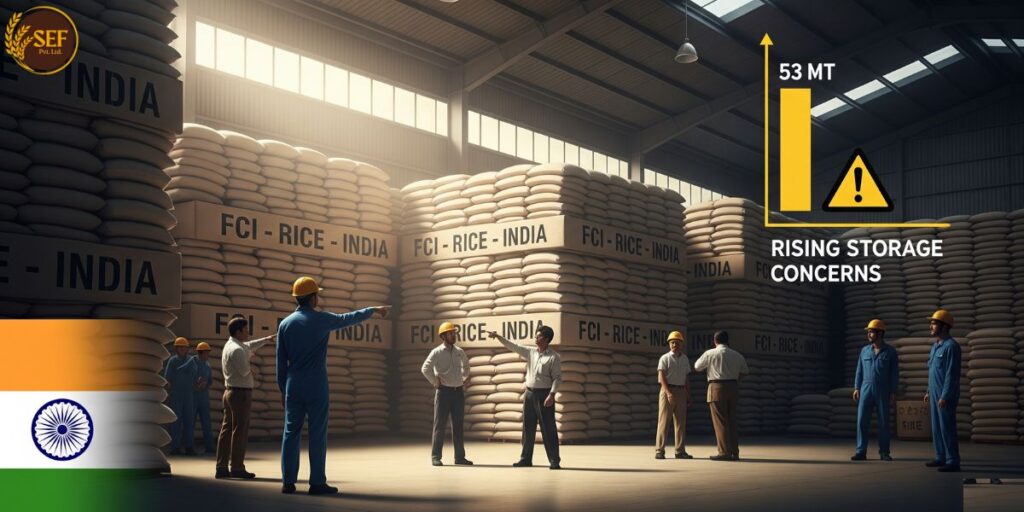
Rising Stocks Create Storage Concerns
Rice stocks with the Food Corporation of India (FCI) have touched 53 million tonnes (MT), more than four times the buffer norm. This build-up comes despite record sales through open markets, ethanol supply, and welfare allocations. Moreover, around 14 MT of rice have yet to be received from millers, adding to the inventory.
The paddy procurement season for 2025–26 begins on October 1, raising concerns about storage space as fresh arrivals enter warehouses. Experts warn that surplus grain could push subsidy costs higher if stocks are not reduced in time.
High Procurement Adds to Surplus
Strong procurement under the minimum support price (MSP) and robust crop output are key reasons behind the rising stock. Each year, the FCI and state agencies purchase 52–53 MT of rice from farmers. Moreover, 36-38 MT are allocated for the Pradhan Mantri Garib Kalyan Anna Yojana (PMGKAY), which provides free foodgrains to 810 million people.
During April–August 2025, FCI supplied rice for ethanol (1.97 MT), state welfare schemes (1.41 MT), e-auction (0.72 MT), and Bharat rice (0.06 MT). These sales already surpass last year’s levels, showing strong demand. Still, the pace of procurement is outstripping distribution.
For buyers and traders, tracking Indian rice prices and government distribution strategies is becoming crucial. Furthermore, high procurement affects not only market supply, but also the global standing of the top 10 rice exporters in India.
Subsidy and Cost Pressures
The government faces a rising subsidy burden due to high storage and handling costs. At the start of FY25, the economic cost of rice (MSP, storage, and transport) was estimated at ₹41.73 per kg. With large reserves, costs are expected to climb further.
- ₹2,250/quintal for ethanol and states.
- ₹2,400/quintal for Bharat rice.
- ₹2,800/quintal for bulk e-auction purchases.
Additionally, if rice stocks are not reduced to manageable levels, subsidy expenses will surpass the estimated 2.03 lakh crore for FY25. Actual arrivals of freshly milled rice will begin by December 2025, after procurement ramps up from October.
Conclusion
India’s rice surplus highlights the dual challenge of supporting farmers while managing storage and subsidy costs. Strong procurement policies have ensured food security, but record stocks now test warehouse capacity. Meanwhile, global importers are closely watching Indian rice prices and supply movements, since they play a key role in determining how the top 10 rice exporters in India perform in the global market.