

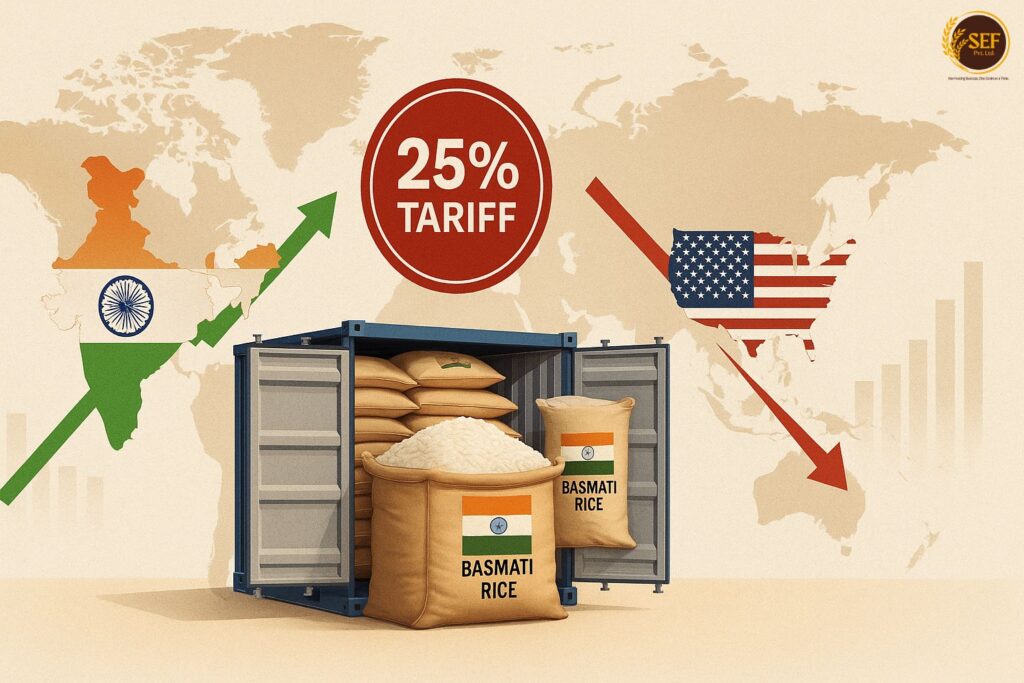
India’s rice export industry is showing strong resilience despite the United States announcing a new 25% tariff on Indian rice and other goods, effective from August 1, 2025. Furthermore, the Indian Rice Exporters Federation (IREF) considers this move to be a temporary problem rather than a long-term disruption.
India’s Global Rice Trade: A Broader Context
In the 2023–24 financial year, India exported around 52.4 lakh metric tonnes (LMT) of Basmati rice across the globe. Out of this, only 2.34 LMT was exported to the United States. This indicates that the U.S. holds less than 5% of India’s total Basmati exports.
Meanwhile, West Asian countries such as Saudi Arabia, UAE, and Iran continue to be India’s largest buyers of Basmati rice, making the U.S. an important but non-central market for Indian exporters.
Industry Response: Temporary Hurdle, Not a Major Disruption
According to Prem Garg, National President of IREF:
“This tariff is a temporary hurdle, not a long-term roadblock. We are confident in the resilience of our exporters and their ability to navigate market shifts.”
The industry is focusing on strategic planning, market diversification, and policy engagement to minimize disruptions and maintain export volumes.
India’s Competitive Tariff Advantage
Despite the 25% U.S. tariff on Indian rice, India remains competitively positioned compared to other major rice-exporting countries. Here’s how:
| Country | Tariff on Rice Exports to U.S. |
| China | 34% |
| Vietnam | 46% |
| Thailand | 36% |
| India | 25% |
This gives India a tariff advantage, helping it remain a cost-effective supplier in the U.S. market even after the hike.
Focus on Diversification and Policy Engagement
IREF, representing over 7,500 rice value chain stakeholders, is actively:
- Engaging with Indian trade and commerce ministries
- Exploring new market opportunities in Africa, Europe, and Latin America
- Encouraging exporters to diversify product lines and reduce overdependence on any single country
This broader approach ensures long-term stability for Indian rice exports.
Conclusion
While the new 25% U.S. tariff introduces short-term pressure, India’s rice export industry remains robust and adaptable. With lower comparative tariffs, continued global demand, and proactive export strategies, India is well-positioned to maintain and even grow its presence in global rice markets.
Partner with Shah Enterprises, your trusted export partner offering competitive Indian rice prices, reliable logistics, and global reach.
 Chat on WhatsApp