

Overview
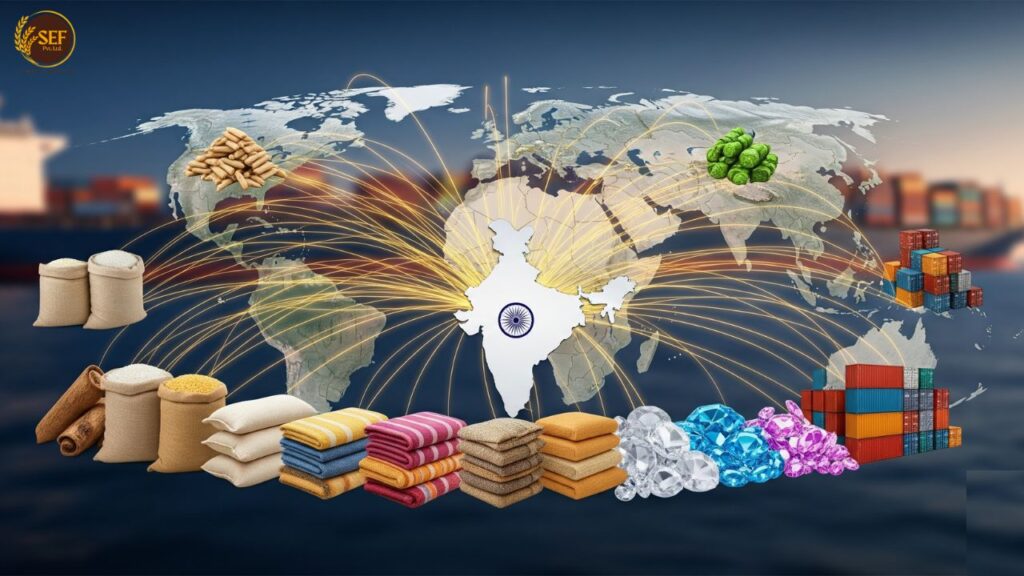
India is rapidly diversifying its export markets to reduce dependence on the United States, shifting focus toward 50 countries, especially in West Asia and Africa. In addition, this strategic shift aims to mitigate the economic impact of steep U.S. tariff hikes, which have doubled from 25% to 50%, impacting key sectors such as agriculture, textiles, leather, marine products, and gems.
Agriculture and Trade Implications
The move has direct implications for India’s agricultural exports, including rice and other agri-based products, which are integral to the nation’s trade profile. Further, diversifying markets helps agriculture remain resilient despite shifting global trade dynamics.
The Policy Shift
According to The Economic Times, these targeted markets collectively account for nearly 90% of India’s total exports. The Ministry of Commerce and Industry is conducting a detailed, product-by-product review to identify India’s competitive strengths and benchmark them against global competitors. Furthermore, this process involves close coordination with export promotion bodies to develop market-specific strategies.
Impact of the U.S. Tariff Hike
Washington’s decision to double import duties on Indian goods, raising them from 25% to 50%, places them at par with Brazil’s rates, making them the highest for any country. Further, the first 25% hike was enacted last week, while the additional 25% will take effect on 27 August 2025.
Sectors such as agriculture (including rice), textiles, leather, marine products, and gems are expected to feel the greatest pressure.
Also Read – Trump Hits India with 50% Tariff Over Russian Oil Deal, Exports at Risk
Competitive Disadvantage
Key competitors like Turkey, Vietnam, and Thailand will continue to face significantly lower U.S. import duties of 15%, 20%, and 19%, respectively.
“The U.S. is our single largest market, accounting for over $10 billion in exports, nearly 30% of our industry’s total global trade. A blanket tariff of this magnitude is severely devastating for the sector,” said Kirit Bhansali, Chairman of the Gem and Jewellery Export Promotion Council.
Also Read – Global Demand For Premium Basmati Rice Rises: Top Opportunities for Indian Exporters
Government Response
To address these challenges, the government is:
- Launching customized schemes under the upcoming Export Promotion Mission
- Promoting under-exported products in domestic and global markets
- Expanding the list of priority export countries from 20 to 50
- Redirecting goods toward high-growth, low-tariff markets
Challenges in Diversification
Industry leaders warn that trade diversion through low-tariff nations such as Mexico, Canada, Turkey, UAE, and Oman could undermine transparency in trade practices. This remains a key concern for policymakers alongside market diversification.
Also Read – India-UK Trade Deal Set to Boost Agricultural Exports by 20% in 3 Years
Conclusion
While higher U.S. tariffs create short-term strain, India’s expanded export strategy, covering agriculture, rice, and other key sectors, positions the country to remain competitive globally. Strategic diversification and proactive policy measures will be crucial to sustaining growth. For the latest updates on Indian rice prices, visit Shah Enterprises‘ insights section.