

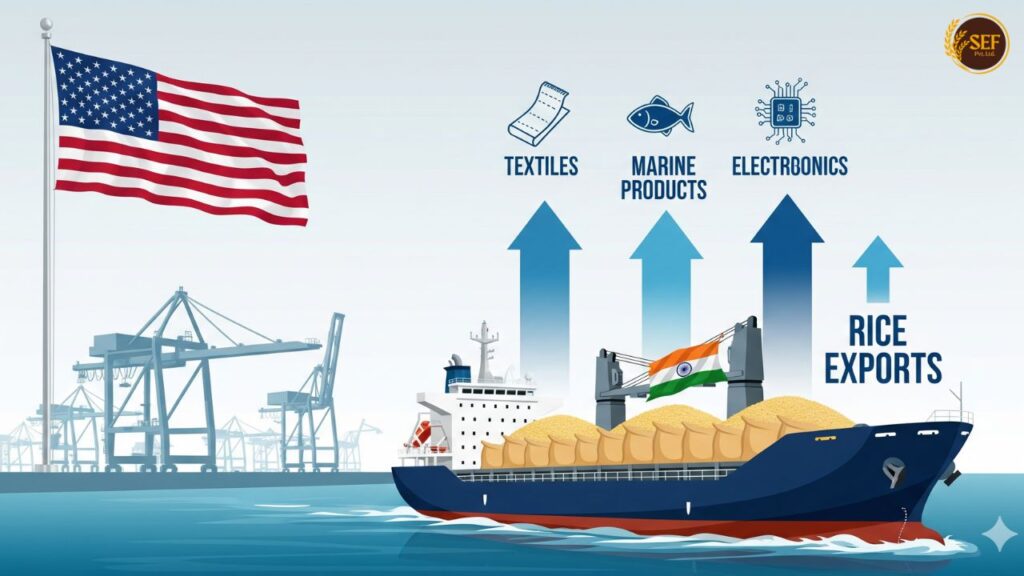
India’s export sector has been shaken by Washington’s sudden decision to impose tariffs of up to 50% on key goods. The move has created deep concern across industries. Marine products, textiles, gems, automobiles, and electronics worth nearly ₹7.25 lakh crore now face an uncertain trade future. Economists warn that these duties could shave 0.6% off GDP growth, leading to a potential loss of nearly ₹48,000 crore this year.
Experts Eye Rice as a Strategic Buffer
Despite the uncertainty, analysts see rice exports as a possible cushion. India shipped rice worth ₹83,000 crore globally last year. Only ₹3,200 crore of this went to the US, but experts believe redirecting surplus rice to other markets can soften the tariff impact.
Prof. Govind Rao, a noted economist, said: “India has surplus stocks of rice. Whatever is not required domestically should be exported. But this requires reforms. Universities must help by developing high-yielding and profitable varieties.”
Former ISEC director Prof. R.S. Deshpande agreed, stressing that rice exports could offset losses in marine and textile sectors. He added that demand remains strong in Western Europe, West Asia, and Africa.
Also Read – Global Demand For Premium Basmati Rice Rises: Top Opportunities for Indian Exporters
Pressure on Other Export Sectors
Marine exporters, especially shrimp farmers, now face tariffs of more than 58%. This threatens India’s edge against Ecuador. Industry leaders expect a loss of nearly ₹600 crore and a 20% dip in volumes. The textile sector could suffer even more. Estimates suggest a ₹75,000 crore loss, which may threaten close to one million jobs.
Also Read – India Set to Become the World’s Largest Rice Producer in 2024–25
Rice as an Economic Lever
The resilience of Indian rice prices on the global stage continues to highlight India’s role as a reliable supplier. With top 10 rice exporters in India already contributing significantly to international trade, policymakers may look to liberalize rice shipments. Additionally, this move could ease exporter burdens while ensuring surplus stocks are utilized effectively.
Also Read – India-UK Trade Deal Set to Boost Agricultural Exports by 20% in 3 Years
Conclusion
While the tariff shock from the United States casts a shadow over India’s export economy, rice exports emerge as a potential stabilizer. By easing restrictions and capitalizing on strong global demand, India could mitigate some of the projected losses and strengthen its position as one of the world’s leading rice suppliers.