

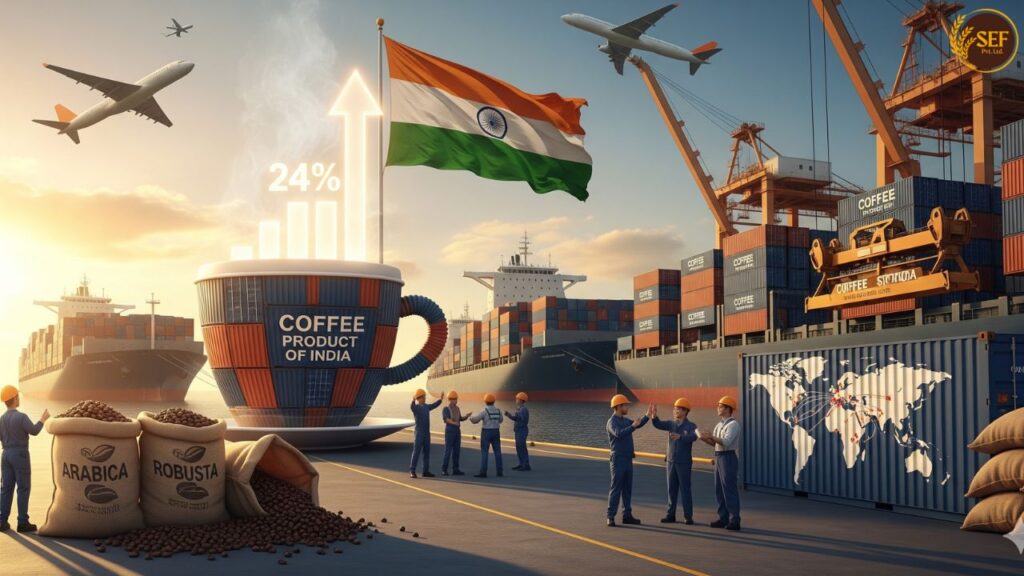
India’s coffee exports recorded strong growth in 2025, with higher realisations offsetting a decline in shipment volumes. Between January and August, exports stood at $1.46 billion, marking a 24% increase compared to $1.18 billion a year ago. As a result, rupee-adjusted shipments increased 28% to ₹12,673 crore, thanks to both a weak currency and a global price uptrend.
Higher Realisations Drive Export Value
Coffee Board data shows the unit value per tonne surged 45% to ₹4.72 lakh, up from ₹3.25 lakh a year earlier. The rise came mainly from strong international demand and tight supplies in Brazil and Vietnam.
Total shipments fell 11% to 2.68 lakh tonnes, yet value growth highlighted India’s strong global position. Arabica exports rose 11.5% to 40,674 tonnes, while robusta shipments declined 22%.
EU Demand for EUDR-Compliant Coffee
A challenge for Indian exporters is the growing insistence of European buyers on EUDR-compliant coffee. The EU deforestation law will be enforced in December 2025, but buyers want compliance ahead of time.
The rule requires exporters to prove coffee is not sourced from deforested areas after December 31, 2020. Many growers and traders are still preparing for full compliance, which has slowed robusta shipments. Exporters are now working on stricter risk assessments and mitigation measures.
Farm Gate Prices Rebound
On the domestic front, farm gate prices in India have rebounded after months of decline.
- Arabica parchment: ₹27,300–₹27,800 per 50 kg bag
- Arabica cherry: ₹14,000–₹16,200 per bag
- Robusta parchment: ₹17,500–₹18,000 per bag
- Robusta cherry: ₹11,500–₹12,500 per bag
However, this rebound, in line with the global price trend, has also contributed to higher export realisations.
Linking Coffee to Broader Agri-Trade
India is not only strengthening its coffee exports but also playing a leading role in global grain trade. With strong demand for rice prices in India and growing recognition among the top 10 rice exporters in India, the country continues to expand its agricultural export footprint.
Alongside rice, India’s rising position in the coffee market further enhances its credibility in global food trade. Businesses worldwide are now exploring opportunities to export coffee from India, attracted by its quality, diversity, and growing compliance with international standards.
Conclusion
India’s coffee exports in 2025 highlight a market driven by quality, compliance, and rising global prices. Despite lower volumes, higher per-unit realisations have kept revenues strong. Furthermore, Indian exporters are confronted with challenges and opportunities as European buyers insist on sustainable and EUDR-compliant supply chains.