

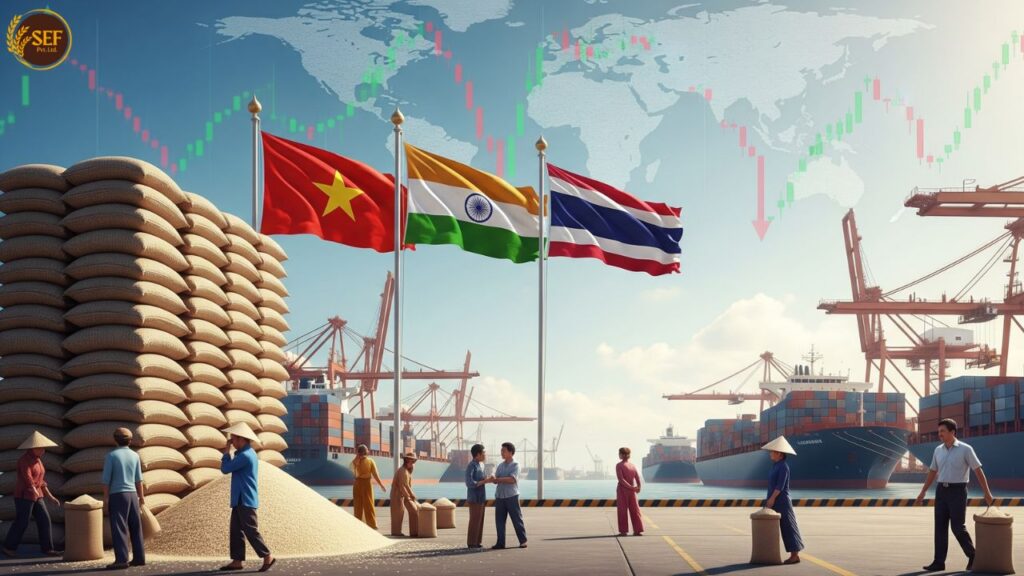
Rice markets across Asia recorded mixed price movements this week, with Vietnam and India showing upward trends, while Thailand leaned on government measures to support its farmers. A number of factors, such as exchange rates, supply cycles, and trade policies, continue to influence rice prices in the region.
Vietnam and India See Price Gains
Vietnam’s 5% broken rice rose to $399 per metric ton, up from $395 last week. Domestic supplies have tightened, pushing prices higher. Traders explained that the country’s focus on high-quality rice varieties has helped offset weaker demand from the Philippines, which recently reduced its imports.
By mid-August 2024, Vietnam had already exported 5.88 million tonnes of rice. This figure marks a 3% increase compared to last year, according to official data. The rise demonstrates Vietnam’s growing role in premium rice markets.
In India, the 5% broken parboiled variety was quoted at $371–$376 per ton, slightly above last week’s range of $369–$374. White rice prices stood at $363–$369 per ton. Analysts noted that the increase was supported by the rupee’s appreciation and stronger demand at lower price levels. This shift has made Indian shipments more competitive in the global market.
The firming of Indian rice prices highlights continued global interest in the country’s supply. Both parboiled and non-basmati varieties remain vital to importers. This further strengthens India’s position among the best rice exporters in Asia and worldwide.
Also Read – Global Demand For Premium Basmati Rice Rises: Top Opportunities for Indian Exporters
Thailand and Regional Outlook
Thailand’s 5% broken rice inched up to $365–$370 per ton from $355–$360 a week earlier. However, traders reported that abundant global supply continues to pressure exporters, limiting price gains.
To stabilize incomes, the Thai government approved a 106 billion baht ($3.26 billion) package, including direct payments and loan guarantees for farmers. Additionally, these measures protect farmer earnings and maintain production levels even when global demand softens.
Elsewhere in Asia, supply conditions remain mixed.
- Indonesia reported strong harvests, reducing the need for imports.
- The Philippines restricted imports of older rice stocks, adding to regional supply balance.
- Bangladesh imported 1.44 million tonnes of rice in FY2024, the highest in seven years, after severe flooding reduced local production.
In addition, these factors illustrate how weather events, policy shifts, and currency fluctuations continue to affect rice trade in Asia’s interconnected markets.
Also Read – India-UK Trade Deal Set to Boost Agricultural Exports by 20% in 3 Years
Conclusion
While Vietnam benefits from stronger demand for fragrant varieties and India gains from improved exports, Thailand continues to rely on support programs to maintain farmer stability. Across Asia, prices remain sensitive to supply changes and policy decisions, making it essential for global buyers to watch these shifts closely.
In particular, monitoring Indian rice prices alongside the strategies of the best rice exporters in India will be crucial to understanding how Asia’s rice market evolves amid currency movements, trade restrictions, and shifting consumer demand.